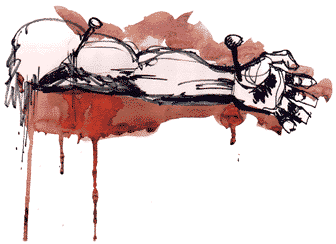
The adventures
of Beowulf, Episode 5
--The Speeches--
Hrothgar, standing on the steps,
seeing the golden roof
and
Grendel's hand, spoke:
"For this sight I give
thanks to the
Almighty.
I have suffered much
from Grendel's scourge.
God, the
glorious protector,
works wonder after wonder.
Only yesterday I
expected
these woes would never end--
this best of houses
stood
shining in blood
and all my wise ones said
we could never protect
the people and land
from the work of demons
and evil spirits.
Now
a warrior, through God's might,
has performed a deed we,
in
our wisdom, could not contrive.
The woman who bore you,
Beowulf, if
she yet lives,
may say the Eternal Maker
was kind in her child
bearing.
Now, Beowulf, best of warriors,
I love you as a
son:
have from this moment
a new kinship. Nor will there be
any
lack of earthly things
I have power over.
Often I have given
gifts
to a lesser warrior, weaker
in fighting. You have, by
your
deeds, achieved fame
forever. May God repay you
always as He has
just now!"
Beowulf, son of Ecgtheow, spoke:
"We have done this work of
valor
against the strength of an uncanny
foe. I wish you might have
seen
this enemy killed in his gear.
I planned to bind him
quickly
to his deathbed with hand grips.
I thought I could pin him
down
struggling for life without
his body's escape. But I could not
keep him from going; the Creator
did not will it, and I could not
hold him firmly enough. The foe
was too powerful in his going.
However, he left behind his hand
to save his life, and his arm
and shoulder, though that won't buy
the wretch much comfort.
The
evil-doer, afflicted by sin,
won't live much longer;
pain with its
strong grip
has seized him in deadly bonds,
and there shall he
await,
guilty of crime, the great judgment,
how the bright
creator
will decree. . . "
Then was the warrior silent
in speaking of his war-like deed,
and
the nobles beheld
the hand at the high roof.
On each of the foe's
fingers
were nails like steel.
Everyone agreed the heathen's
claw
was horrible
and that the wretch's
bloody battle hand
could not
be harmed
by the best of iron.
Entertainment in Herot
Then it was ordered
that Herot be decorated.
Many there were,
men and women, who
prepared that guest-hall.
Gold ornaments
shone,
wondrous sights on the walls,
for people to look at.
That
bright building
had been much hurt,
though its bands
were made
of iron.
Hinges had been sprung
apart. The roof alone
had escaped
damage before
that monster, wicked outlaw,
turned in flight
despairing of his life.
(Fate is not easy
to flee from,
try
it who will--
the children of men,
bearers of souls,
must go to
the prepared place,
his body rest
fast in the grave,
sleep after
the feast.)
Then came the time
that Hrothgar himself
went to the
feast.
Never have I heard
of a greater company
gathered around a
treasure giver.
Great ones sat at the benches
and rejoiced with the
cup.
Those brave kinsmen
drank many a mead cup
in the high hall
with
Hrothgar and Hrothulf, his nephew.
Herot was filled with
friends
(treachery had not yet
come to the Danes).
Hrothgar gave Beowulf
a gilded banner,
decorated battle
flag,
as reward for victory.
Also a helmet, armor, and
a famous,
precious sword
were given to the hero
before that company.
Around
the helmet's top
as head-protection was
a wrap of metal bands
so
that no sharpened swords
could harm him
in the battle storm
when
the shield-warriors fight.
Beowulf drank the cup.
He had no reason to be
ashamed among
warriors
for taking those rich gifts.
Never have I heard
of
golden treasure given
at the ale bench in
a more friendly way.
The king ordered eight horses
with gold-plaited bridles
led into
the hall.
On one sat a saddle
inlaid with jewels--
it had been
Hrothgar's
when he had gone to sword play.
Never had he failed
at
the front
when corpses fell.
Hrothgar gave horses and
weapons,
telling Beowulf to enjoy them well.
Thus like a man
that
great prince,
treasure giver of heroes,
repaid Beowulf for his
battle,
and no man who tells the truth.
will blame him. Then that
chief of nobles
gave to each one on the mead bench
who had taken the
ocean's way
with Beowulf an heirloom
and ordered that the
one
Grendel killed in wickedness
should be paid for in
gold.
(Grendel would have killed
more of them if wise God,
and
Beowulf's courage,
had not prevented it.
The Creator then ruled the
race of men,
as He does yet; and, therefore,
understanding is
best:
the forethought of mind.
Much shall he abide,
from friends
and foes,
who lives long in these
days of strife as he
makes
use of this world!)
The Poet Sings Of Old Trouble, how Hildeburh, married to stop a feud between Jutes and Danes, saw her husband, brother, and son killed
In the presence of the battle leader
Hrothgar's poet touched
the
harp and recited
many songs for entertainment
in the hall. He sang
of Finn's offspring and how
Hnaef of the Danes fell
in a Jute
battlefield.
Indeed Hildeburh did not have
much cause to
praise
the good faith of her in-laws,
the Jutes: though blameless,
she was deprived of dear ones
by the shield play, both her son
and Hnaef, her brother, in fate
fell to spear wounds.
That was
a sad woman.
Not without cause, after
morning came, when she could
see under
the sky,
did she bewail the decree
of fate, the slaughter
of
kinsmen. At first she had
possessed the world's joy.
War took all
but
a few of the Jute men
so they could not
fight the Dane Hengst
nor
protect the survivors.
But Hengst offered
them a deal: that
the Jutes would
make
room for the Danes
in the beer hall and
that with
gifts
King Finn would honor
Hengst's men, rings,
entertainment,
and treasures
of plated gold as if
they were his kin.
Both
sides agreed to the peace.
Finn declared to Hengst
honest oaths that the survivors
would be
held in honor
and that no man,
by words nor works,
would break
the peace
nor in cruelty mention
that they were being
friendly
with the killer of their king,
since a winter freeze
had
forced it. If any of the Jutes
in daring speech mentioned
it,
then the edge of the sword
would settle the matter.
A funeral pyre was readied
and gold brought from the hoard.
The
best of the Danes
were ready for the pyre.
At the fire were blood
stained
shirts of mail, boar images
all golden and iron-hard.
Not
a few noble ones
had been destroyed by wounds!
Hildeburh ordered her son
committed to the heat
of Hneaf's pyre;
his muscles burned
at the shoulder of his uncle.
The woman mourned,
sang lamentation,
as the warrior ascended,
waned to the
clouds,
as the greatest of death fires
roared on the
barrow.
Heads melted,
wounds, hostile bites
to the body,
opened
and burst; blood
sprang out. Fire,
the greediest of
spirits,
swallowed everything,
of both peoples, there
together.
Their power had passed away.
The warriors departed,
bereft of friends,
to seek shelter
in
the Jute land,
Jute homes and stronghold.
So Hengst spent
a
slaughter-stained winter
with Finn because
he could not leave.
He
thought of home
but could not go
in a ring-prowed ship
against
the sea storm,
against the wind.
The water waves locked
in icy
bindings until
another year came
to the gardens,
as they do
yet,
glorious bright weather
to watch over the hall.
When winter had passed
and earth's bosom turned
fair, the
adventurer was
eager to go, the guest
from the dwelling, but first
Hengst thought more of revenge
for injury than of a sea
journey,
how he might cause
a hostile meeting
with the
Jutes
to repay them with iron.
So it was he did not complain
when
the son of Hunlaf
laid Battle Bright,
the best of swords,
whose
edges were
known to the Jutes,
on his lap.
So it was that
Finn,
bold in spirit,
in his turn met
a cruel death by
sword
in his own home
after Guthlaf and Oslaf
complained of their
sorrows,
blaming their woes
on that sea journey.
A restless
spirit is not
restrained by the breast.
Then was the hall reddened
with the life blood of enemies.
King
Finn was slain
and Hildeburh taken.
The Danish warriors
carried
to their ships
all the goods they could find
in the house, precious
jewels.
They took the queen
on a sea journey
back to her
people.
The poet's song was sung,
the mirth rose, bench noise,
as the cup
bearers offered
wine from wondrous vessels.
end of episode five
* * *
In episode
six Grendel's mother gets mad!