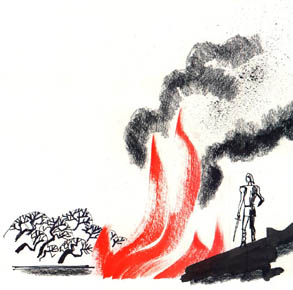
The adventures
of Beowulf, Episode 7
--The Expedition to Grendel's
Mere--
A horse with plaited mane
was saddled for Hrothgar:
the wise king
rode in splendor,
a band of men marching on foot.
Tracks were clearly visible
going over the ground
along the
forest paths
where she had gone forth
over the murky
moors
carrying the good warrior,
the best of men, lifeless,
a man
who had helped
Hrothgar guard his home.
The noble Hrothgar passed
over narrows, lonely paths,
steep,
stony slopes
on that unknown way
among steep bluffs
and the
homes of water monsters.
He and the wise men
went before the rest
to scout the
place,
and suddenly, he saw
a joyless woods leaning over
turbid
and bloody water.
For all the Danes
it was grievous, and
the
warriors suffered
when they on the sea
cliff saw Aeschere's
head.
The water boiled with blood
and hot gore as the men
watched.
Sometimes a horn sang out,
an eager war song, but
the troop all
waited, watching
along the water the kin
of snakes, strange sea
dragons,
swimming in the deep or
lying on the steep
slopes--
water monsters, serpents, and
wild beasts, such as the
ones
that appear on a dangerous
sea journey in the morning
time.
When those creatures heard
the war horn's note
they
hurried away
bitter and angry.
A man from the Geat
tribe with his bow
deprived of life,
of
wave battle, one
of the monsters. An
arrow, war hard,
stuck
in its heart, and it
swam more weakly
as death took
it.
Quickly it was attacked
in the waves with barbed
spears and
swords and
dragged by force to the
bluff, a wondrous sea roamer.
Warriors examined
the terrible stranger.
Beowulf arrayed himself
in armor, not at all
worrying about his
life,
putting on his mail shirt,
large and decorated,
woven by
hand so that
it could protect his chest
as he tried the water,
so
that hostile grips,
the fury's malicious grasps,
might not scathe
his life.
A shiny helmet protected the head
that would go to the watery
depths.
It was adorned with treasures,
encircled with splendid
chains--
in the old days weapon-smiths
formed it wondrously,
setting
on it boar figures so that
no sword could bite it in
battle.
And it was not the weakest of helps
Unferth, Hrothgar's
spokesman,
loaned: the hilted sword called
Hrunting, an ancient
treasure
with edges of iron and adorned
with poison strips. That
sword,
hardened in blood, had never failed
a man who grasped it in
hand
and dared a terrible journey,
battles in a hostile place.
This would not be the first time
it had gone to do brave
work.
Unferth, great of strength,
did not remember what he had
said, drunk on wine, but loaned
his weapon to a better sword
warrior: he himself did not
dare venture his life
under the
terrible waves
to perform a deed of valor.
There he lost his
fame,
his renown for valor.
This was not so for that other man,
he who prepared himself for
war.
Beowulf, son of Ecgtheow, spoke:
"Remember, Hrothgar, kin of
Healfdene,
gold friend of men, wise king,
now that I am ready to
start,
what we have spoken of--
if I, in your service,
lose my
life, that you
will be in position of my father.
Be a protector of
my warriors,
my comrades, if war takes me.
Also, beloved
Hrothgar,
send the treasure you gave me
to Hygelac, king of the
Geats,
that he may perceive from the gold,
beholding the
treasure,
that I found a virtuous ring giver
who I enjoyed while I
could.
And give Unferth my old heirloom,
my splendid wavy
sword
widely known among men
to have a hard edge.
I will do my
glory work
with Hrunting--or
death will take me. . ."
With these words
the chief of the Geats,
waiting for no
reply,
hastened with bravery.
The surging water took
the warrior,
and it was
a good part of a day
before he found the bottom.
She who had fiercely guarded,
grim and greedy, that water
for a
hundred half-years
quickly saw that some man
from above was
exploring
the monsters' home. Then
the enemy seized the
warrior
in her horrid clutches, yet
he was not injured--the ringed
armor protected him, and she
could not break his mail shirt
with her hostile claws.
The sea wolf bore
the armored warrior
down to her dwelling
at the bottom. He could not,
despite his bravery, command
his
weapons--many a sea beast
harassed him with battle tusks,
trying to
cut his armor.
Then the chief found
that he was with someone
in a hostile
hall.
The flood's rush
could not harm him there
because of the
hall's roof.
He saw a firelight shine
in a brilliant flame.
Then the warrior
saw
that monster of the deep,
the mighty mere-woman.
He swung his battle sword
quickly--he did not hold
back--and the
ringed blade
sang a greedy war song
on her head. But the
guest
found that the flashing
sword would not bite,
could not
harm her life--
the edge failed him at need.
(It had endured many
combats, often slashed helmets
and fated war garments. . .
This
was the first time
that precious treasure
failed in its glory.)
But Beowulf was resolute,
by no means slow in valor,
still
thinking of daring deeds.
The angry warrior threw
the carved sword
covered
in ornaments, stiff and edged
in iron, to the floor
and
trusted in his powerful
hand grip. (So must a man do
when he
wishes for enduring
fame at war: he cannot
The lord of the Geats
did not grieve at the battle
but seized Grendel's mother
by the
shoulder.
Now he was enraged
and flung his deadly foe
to the
ground.
She paid him back quickly
with angry claws and
clutched him
against her.
At that moment
the strongest of warriors
felt sick
at heart:
he fell. She sat
on her hall guest
and drew a
dagger,
wide and brown-edged--
she would avenge her son,
her only
offspring.
On his shoulder lay
the woven mail shirt.
It protected his
life,
withstood the entrance
of point and edge.
Beowulf, son of
Ecgtheow,
champion of the Geats,
would have perished then
under
the wide ground
had not his armor,
his hard war net, helped
him
(and Holy God, who
brought about war victory).
The wise ruler of the skies
decided justice easily when
Beowulf
stood up again:
there among the weapons
he saw a victory-blessed
sword,
an old sword made by giants
with strong edges, the
glory
of warriors. It was
the choicest of weapons,
good and
majestical,
the work of giants, but
larger than any other
man
could carry to battle sport.
He who fought for the Danes,
fierce and sword grim,
despairing
of life,
seized the chain-wound hilt,
drew the ringed sword,
and
angrily struck--
It grasped her neck hard
and her bone rings
broke.
The blade entered
the fated body.
She fell to the
ground.
The sword was bloody,
and the warrior rejoiced
in his
work.
Suddenly light glittered,
a light brightened within,
as bright
and clear as
the candle of the sky.
He looked around the
building,
walked around the walls.
He raised the weapon
hard by
its hilt--
Beowulf was angry and resolute.
The edge was not
useless
to the warrior--he wished
to requite Grendel for
the many
attacks he
had made on the Danes,
much more often
than on one
occasion,
when he had slain
Hrothgar's guests in their
sleep.
Fifteen Danish men
he devoured while they slept,
and
carried as many away,
hideous booty. The fierce
champion paid him
his reward:
Beowulf saw Grendel in rest,
worn out with
fighting,
lifeless from the hard wounds
he had gotten in battle
at Herot. The corpse
split when it suffered
that blow after
death--
the hard sword stroke.
Beowulf cut off the head.
end of episode seven
* * *