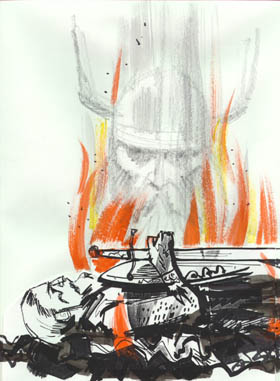
The adventures
of Beowulf, Episode 12
-- The Death of
Beowulf--
The wound began
to swell and burn,
the venom seethed,
that
poison inside.
The prince went
to sit by the wall,
the wise man
sat down
to look at the work
of giants held within
the
earth-house standing
on stone pillars.
Wiglaf bathed him,
his lord,
wearied in battle,
and unfastened
his helmet.
Beowulf spoke,
despite his wounds.
(He knew well
he'd seen the
last
of this world's joys,
that he'd numbered
his last
day.)
"Now should I give my sons
my battle garments,
but fate did
not grant
that I have sons.
I ruled the people
fifty
winters.
Not one king among
the neighboring peoples
dared greet
me
with a sword;
I feared no one.
I awaited my destiny
well:
never did I plot a quarrel,
never did I swear
an unjust
oath.
I take joy in this,
despite a mortal wound.
The Ruler of
Mankind
will not charge
that I murdered a kinsman
when my
life
departs this body.
Go quickly, Wiglaf,
examine the
hoard
under the gray stone
now that the dragon lies
sleeping of a
wound,
bereft of his treasure.
Be in haste
so that I may
see
the ancient treasure,
may examine
the curious gems,
so
that I may
more cheerfully give up
my life and country."
Wiglaf hurried
from his wounded lord,
obeyed the battle-sick
one,
rushed in his mail
under the cave's roof.
There by a
seat
the brave young man saw
many precious jewels,
shining gold
on the ground,
and works of art
on the walls.
There in the
dragon's den
Wiglaf saw the cups
of ancient men,
ornaments
fallen.
There were helmets,
old and rusty,
and many
arm-rings
twisted with skill.
(Treasure, gold in
the ground, may
be easily
seized by any man,
hide it who will.)
Wiglaf saw a standard
all golden high
over the treasure,
the
greatest of hand-wonders,
woven with the skill of hands.
From it a
light shone,
lit all the ground
so he could look
over all the
treasures.
Then, I have heard,
he rifled the hoard and
into his
bosom loaded
the ancient work of giants--
goblets and
dishes,
whatever he chose,
even the golden standard.
The sword,
the iron edge,
had carried off
the guardian who
for a long
while
carried surging fire
in the middle of the sky.
Wiglaf was in haste,
eager to return
with these great
treasures;
he feared the great spirit
might be dead
in the place
where he lay.
With the treasure
in his hands
he found his
lord
bloody and weak.
He bathed Beowulf
until he could
speak,
until words broke
from his breast-hoard.
The king, aged in sorrow,
beheld the gold and spoke:
"I thank the
Wonder-King,
the Ruler of All,
that I could win this
for my
people
before my death-day.
I have traded
my old life for
the
people's needs.
I cannot remain.
Bid my warriors
raise a splendid
mound
on the shore-cliffs
after my funeral fire
that a
remembrance shall
tower high on Hronesness.
Sea-farers shall
afterward
call it Beowulf's Mound
when they pilot ships
far over
the ocean's mists."
He unfastened from his neck,
his golden necklace, gave it
to the
brave young warrior,
and a gold-trimmed helmet,
a ring, and
mail.
He bid him use them well.
"You are the last
remnant of our
kin,
of the Waegmundings.
Fate has swept
the rest away,
those
courageous warriors.
I follow them."
Those were the aged king's
last words, thoughts from
the heart,
before he tasted
the funeral-fire,
that hot, hostile flame.
His
heart departed, his soul,
to seek glory.
Wiglaf Speaks to the Cowards
The young man looked
on his beloved lord,
wretchedly
killed,
lying on the ground.
His killer, the terrible
cave-dragon, also lay
bereft of life, overwhelmed
in
destruction.
The dragon no longer
coiled round the hoard,
but was
taken by iron,
hacked in battle
by the hammer's creation.
He had
fallen
on the ground
near his treasure house.
No longer would he
circle
at midnight
proud in his flames;
he had fallen
before
the prince's
hand-work.
As far as I have heard
no man ever prospered
rushing against that
enemy;
no man ever prospered
who found that dragon awake.
Beowulf
bought the treasures
with his life.
Both of them found
the end of
this life.
Soon the cowards,
the ten warriors,
returned from the
woods,
those who did not dare
fight with spears
when their
lord
needed help.
They carried their shields,
wore their
mail,
in shame
to where Wiglaf sat,
near his lord's
shoulder
trying to wake him
with water.
He did not
succeed--
he could not,
though he much wished it,
hold his chief
in life.
He could not change
the will of God.
The young man
gave a grim welcome
to those who had
lost
courage. Wiglaf spoke,
glaring at the hated ones:
"Lo, this will he
say
who wishes to speak the truth:
that lord of men
gave you
treasures,
the war-equipment
you stand in.
At the ale-bench
he
often gave you. . .
hall-sitters. . .
helmets and armor,
the
most splendid
he could find,
far or near.
He completely
wasted
that armor.
When war came
he couldn't boast
of
warriors.
Still, God granted
victory to him
that he alone
avenged
himself with sword
when he needed help.
I could do little
in battle,
though I undertook it.
It was beyond my measure.
But I
struck the foe
and fire gushed less
strongly from his head.
There
were too few men
around the prince
when he faced
his time of
need.
Now shall the treasure,
the sword gifts
and delightful
homes
given to your people,
cease. You will lose
your land
rights
when men far and wide
hear of your flight,
your shameful
doings.
Death is better
to any man
than a life of disgrace."
He commanded then
that the battle-deeds
be announced
to those
in town,
up over the cliff-side
where the other warriors
the
whole morning
had waited,
sad in heart,
for their lord's
return
or news of his death.
The Messenger Tells of Beowulf's Death and of the Feud Which Will Now Be Renewed
The messenger was not silent
but said truly
to all who
heard:
"Now is the joy-giver
of the Geat people
still on his
death-bed,
his slaughter-couch,
through the deeds
of the
dragon.
Beside him lies
his life-enemy, sick
from a dagger
wound.
His sword could not
in any way
wound the
monster.
Wiglaf, son of Weohstan,
sits by Beowulf, one
warrior
by another,
in the death-watch.
Now may the people
expect a time
of war
when the Franks and Frisians
learn of our king's fall.
A
hard quarrel was made
with the Hugas
when Hygelac went
traveling
in ships
to the land of the Frisians,
attacked the Hetware.
With
a larger army they
brought down that warrior;
he fell among his
troops.
He gave no gifts
to his warriors.
Since then the
Mereovingians
have given us no kindness.
Nor do I expect
kindness from the Swedes--
it is widely known
that Haethcyn, son
of Hrethel,
wounded Ongentheow
near Ravenswood
when the
Geats
arrogantly sought
war against the Swedes.
Quickly
Ongentheow,
old and terrible,
gave a counterblow,
cut down
Haethcyn
and rescued his wife,
that aged woman,
bereft of her
gold,
the mother of Onela and Ohthere.
Ongentheow pursued
his
enemies--
lordless they escaped
into Ravenswood,
and those
survivors,
weary with wounds,
were besieged
by a huge
army.
Often through the night
that wretched band
heard
threats,
how in the morning
he would,
with the sword,
cut them
open,
or hang them from trees,
a sport for birds.
Help came to
them
with the early dawn
when Hygelac
sounded his
trumpet,
came up the road
with picked warriors.
The bloody tracks
were widely
seen, the bloody feud
between Geats and
Swedes.
Ongentheow was forced
to seek higher ground,
the old
man
with his kinsmen--
he quickly learned
of Hygelac's
war,
did not believe
he could not withstand
the war of the
sailors.
The old man retreated
with his children and wife
behind
an earth-wall.
Hygelac attacked the refuge,
overran the
enclosure.
There was Ongentheow,
gray-haired, brought to bay
with
the edges of swords.
He was forced to submit
to the judgement of
Eofor.
Wulf hit him angrily,
struck him with sword
so that blood
sprang
out of his veins,
out under his hair.
But that old
man
was not daunted--
he quickly repaid
that blow with a
harder,
nor could Wulf
return the blow,
for Ongentheow
had
sheared his helmet
so that Wulf bowed
to the
earth,
covered with blood.
(He was hurt, though not yet
doomed.)
As his brother lay,
Eofor, with his broad sword,
an
ancient sword
made by giants,
broke Ongentheow's helmet.
That
king, shepherd of his people,
bowed, mortally wounded.
Wulf was
bound up. They
controlled the slaughter-place.
One warrior plundered
another.
They took from Ongentheow
his iron mail,
his hard
sword,
and his helmet also.
They carried
the old man's
armor
to Hygelac.
He received these weapons
and promised
treasures
to his people,
which he fulfilled,
paying Wulf and
Eofor
for the storm of battle--
gave them both
land and
treasures.
Nor should any man
throughout this world
reproach
those gifts--
they were earned in war.
And to Eofor
Hygelac
gave
his only daughter
as a pledge
of friendship.
That is the
feud,
the deadly hostility
for which I expect
the Swedes will
attack
when they learn our lord
who long protected
over hoard and
kingdom,
is dead.
That most valiant of warriors
will no longer
look after
the needs of our people,
will do no more
heroic
deeds.
Now should we hurry
to see our king
and bring him
back
to a funeral pyre.
Not a little will melt
with that bold
man,
but a huge treasure,
countless wealth,
bought with
grimness
by that brave man.
All that the flames will eat,
the
fire embrace;
no warrior will carry
any of it as a token,
no
beautiful woman
will wear a neck-ring,
but, bereft of gold
they
shall walk
in a foreign country
now that our lord has
forgotten
laughter and joy.
Now shall the spear be
raised,
clasped in hands,
many a cold morning;
now no sound of harp
shall
wake the warrior,
but the voice
of the dark raven,
eager over the
doomed,
speaking to the eagle
of how the meals are,
how he rifles
corpses
beside the wolf."
Thus the valiant warrior
spoke grievous
words.
And he was not much wrong.
The Funeral
The sad troops rose,
went in tears
below Earnaness
to view the
wonder.
Lifeless on the sand,
held in his rest-bed,
was the man
who had
given them treasures.
That was the last day
of the
prince of the Geats;
he died a wondrous death.
There too on the ground
was the strange thing,
the hateful dead
dragon,
the fire-thrower,
in his horrible colors,
scorched by
flames.
He measured fifty feet,
he who had
joyed in the
sky,
flown at night,
then hidden in his lair.
But he'd made his
last
use of caverns--
death held him fast.
Beside him lay
cups and pitchers,
dishes and swords
eaten
through with rust
as if the earth had embraced
them a thousand
winters.
That was a hoard
of great power,
that gold
ancient
men
had encircled with a spell
so that no man
could touch
it,
unless God himself,
the great Truth-King,
gave leave
to
whichever man
seemed fit to Him.
But it was plain
that nothing
had gone well
for him who had,
unrightly, hidden those
works of
art
under that roof.
It's a mystery where
a good man goes
when he reaches his
end,
when he can no longer
live in the houses of men.
So it was
with Beowulf
after he'd sought
the keeper of the cave.
He himself
couldn't know
how he would leave the world.
The famous kings who had
cursed
that treasure deeply
damned him who plundered it
into
eternal heathen shrines,
the solid bond of Hell.
But Beowulf did
not
look on it in greed.
Wiglaf spoke, Weohstan's son:
"Often must a warrior
suffer for
another's mistake,
as has happened here.
Nor could we
convince
our beloved prince
that he should not attack
that
gold-keeper
but let him lie
alone in his cave
until the world's
end.
He grasped
his high fate--
the hoard is open,
grimly
bought.
That fate
was too cruel
to which our king
was
impelled.
I went inside,
saw all the treasure,
the precious
things;
I didn't enter
in a friendly way.
I hastily
grasped
many things in my hands,
carried out many
of the hoarded
treasures
to my lord.
He was alive still,
sound in mind;
that
aged man
sorrowfully said
many things:
He wanted you to
build
on the site of his pyre
a high mound,
great and
glorious,
since he was
among warriors
the most
magnificent,
famous throughout the world.
We should now hasten
to
see the curious gems,
the wonders under the earth.
I will show you
the way.
Make the pyre ready
so that we may bring our lord
to the
place
he will abide
in the keeping
of the
All-Powerful."
Wiglaf ordered
the brave warriors
to
carry wood
from far and wide
to the funeral pyre
for the great
leader
of the people.
"Now shall fire eat,
the
flourishing dark flames,
the ruler of warriors,
he who often
braved
the rain of iron,
the storming of arrows
hard from
bows,
the sturdy shaft
swift on feathered
wings."
Wiglaf called seven warriors,
the very
best,
and made the eighth himself,
to go under
that evil
roof.
One carried a torch.
No man needed forcing
when he saw that
great treasure
rusting without guardian.
None mourned
carrying
that off,
and they shoved the dragon
over the cliff--
the waves
embraced
that treasure guardian.
Then the twisted
gold,
treasure uncountable,
was lain in a wagon;
they carried the
gray warrior
to Hronesness.
For him then
they prepared
a huge
funeral pyre
on the earth,
hung with helmets,
war-shields,
and
bright coats of mail,
as Beowulf had asked.
There they
laid
the famous prince
and lamented
that beloved
lord.
Warriors then built
the greatest of fires.
Wood-smoke
ascended,
dark black over the flames.
That roar wrapped around
sorrowful weeping.
The wind stood still.
Then his bone-house
broke,
the heart burned.
Beowulf's queen uttered
a mournful song, spoke
her heart's care
with her hair
bound tight. She told earnestly
how she feared evil
days,
a great slaughter of warriors,
humiliation and
captivity.
Heaven swallowed the smoke.
The Geats built a mound then,
in ten days, high and broad
on the
hill, a beacon
for the warrior
widely seen by sailors.
They
surrounded the ashes
by a wall, as splendid
as the cleverest
men
could make.
In the mound they placed
rings and bracelets
and all
such things as
they'd found in the hoard.
They left that
treasure
in the hands of the earth,
as it lies still,
as useless
to men
as it had been before.
Then twelve warriors
rode round the grave
speaking their
sorrow,
reciting praises
for their lord's
courageous deeds.
(A
warrior should do so
when his lord dies.)
Thus the Geats
mourned their great lord,
saying he was,
among
this world's kings,
the mildest, the gentlest,
the kindest to his
people,
and the most eager
for eternal
fame.