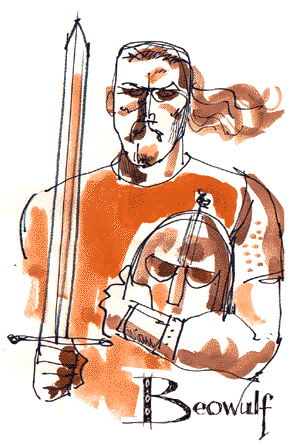
The paved road guided the men.
Their war-coats shone,
the hard
locks ringing
as they came toward the hall.
The sea-weary ones
set
their broad, strong shields
against the building's wall,
then
sat down on benches,
their armor resounding.
They stood their spears
together,
ash wood tipped with gray,
an iron troop.
Then a proud Danish warrior asked them:
"From where have you
carried
these gold-inlaid shields,
these shirts of mail,
masked
helmets, and battle shafts?
I am Hrothgar's messenger and
officer.
Never have I seen braver strangers.
I expect you're
here
to find adventure, not asylum."
The brave one answered him,
he of the proud Geats tribe,
hard
under his helmet:
"We are Hygelac's table companions.
Beowulf is my
name.
I will declare to the great lord,
Healfdene's son, my
errand,
if your prince will greet us."
Wulfgar spoke--he was
of the Wendla tribe
and known to
many
for fighting and wisdom--
"I will ask the lord of the
Danes,
the giver of rings,
if he will reward your journey
and
speedily make his wishes known."
Wulfgar went quickly
to where Hrothgar sat,
old and gray,
with
his most trusted men.
He went before the face
of the Dane's
lord,
knowing the customs of warriors.
Wulfgar spoke to his friendly
lord:
"From far over the sea's expanse
has come a man of the
Geats,
a chief of warriors named Beowulf.
He and his men have, my
lord,
asked to exchange words with you.
Do not refuse the
request,
Hrothgar! These men look worthy
of a warrior's esteem.
Indeed,
the chief among them,
he who guides them, is strong."
Hrothgar, guard of the Danes, spoke:
"I knew him when he was a
boy.
His father is called Edgtheow.
To that man Hrethel of the
Geats
gave his only daughter.
Now his offspring has come
in
bravery seeking a loyal friend.
Seafarers who took gifts
to the
Geats say that he
has the strength of thirty men
in his hand
grip.
Holy God, out of kindness,
has sent this man to us
to save
us from Grendel's terror.
I shall give treasures
to that brave
man
for his impetuous courage.
Be you in haste: go,
call in this
band of kinsmen.
Say to them that they are welcome
to the Danish
people."
Wulfgar, famous warrior,
went to the door:
"My victorious lord,
prince of the Danes,
bids me say he knows
your noble descent
and
that brave men who
come over the sea swells
are welcome to
him.
Come with your war dress,
under your helmets,
to see
Hrothgar, but
let your war shields
and wooden spears await
the
outcome of your talk."
The mighty one arose,
surrounded by warriors,
a mighty band of
men.
Some remained with the weapons,
as the brave one
ordered.
The rest hastened,
as the man guided,
under Herot's
roof.
The great warrior went,
hard under his helmet,
until he stood
within
in his shining coat of mail,
his armor-net sewn by
smiths.
Beowulf spoke:
"I am Hygelac's kinsman and warrior.
I have
undertaken many
glorious deeds. I learned
of Grendel in my native
land.
Seafarers say this place,
the best of halls,
stands idle
and useless
after sundown. Hrothgar,
the wise men among my
people
advised that I seek you
because they know my
strength--
they saw me come from battles
stained in the blood of my
enemies,
when I destroyed a family of giants,
when I endured pain
all night,
killing water monsters,
grinding them to bits,
to
avenge for the Geats
those who asked for misery.
And now I shall,
alone,
fight Grendel. I ask you,
lord of the Danes,
protector
of this people,
for only one favor:
that you refuse me not,
fair
friend of the people,
do not refuse those who
have come so far the
chance
to cleanse Herot.
I have heard that the monster
in his
recklessness uses no weapons.
I, therefore, to amuse Hygelac my
lord,
scorn to carry sword or shield,
but I shall seize my
enemy
in my hand grip and fight,
enemy against enemy,
and let
God decide
who shall be taken by death.
I expect, if he wins,
that
he will eat fearlessly of
the Geat people in this hall
as he
often has of yours.
Nor will you need,
if death takes me,
worry
about a burial--
that solitary one
will carry my corpse,
dripping
with blood,
to a ruthless feast.
If battle takes me,
send this
best of war garments,
this shirt of mail,
to Hygelac--it is
an
inheritance from Hrethel
and the work of Weland.
Fate always goes as
it will!"
Hrothgar, protector of the Danes, spoke:
"Because of past
kindness
and deeds done, you have come,
my friend Beowulf. By a
killing
your father brought about
the greatest of feuds.
He was
the killer of Heatholaf
among the Wylfings. The Geats,
for fear of
war, would not have him,
so he sought us Danes
over the rolling
waves. . .
back when I first ruled,
as a youth, this wide
kingdom
of the Danish people,
this treasure city of
heroes.
Heorogar was dead then,
my older brother,
the son of
Healfdene.
(He was better than I!)
I paid money to settle
your
father's feud, sent
treasure over the water's back
to the Wylfings.
Your father
swore oaths to me.
It is a sorrow for me
to say to
any man
what Grendel has done--
humiliations in Herot--
hostile
attacks on my hall warriors
until they are diminished,
swept away in
Grendel's horror.
God may easily put an end
to that mad ravager's
deeds.
Quite often have men boasted,
over their ale-cups,
drunk
on beer,
that they would meet
Grendel's attack in the hall
with
grim swords. But
in the morning when the daylight
shone, the mead
hall was stained
in gore, the hall wet with
the blood of battle.
And I had
a few less loyal men.
Sit now and feast,
glory of
warriors,
and speak your thoughts
as your heart tells you."
So a bench was cleared for
the Geats and the brave men
sat down
proud in their strength.
A warrior did his duty,
bearing an etched cup
and pouring sweet
drink.
The poet sang in a clear voice,
and in Herot there was the
joy
of brave men, Danes and Geats.
Unferth, Ecglaf's son,
who sat at the feet
of the king of the
Danes,
spoke, unloosing a battle-rune
(The bravery of Beowulf
was
a vexation to him
because he envied any man
on this middle-earth
who had
more glory than himself):
"Are you that Beowulf
who
struggled with Brecca
in the broad sea
in a swimming contest?
The
one who, out of pride,
risked his life in the deep water
though both
friends and enemies
told you it was too dangerous?
Are you the one
who hugged
the sea, gliding through the boiling
waves of the
winter's swell?
You and Brecca toiled
seven nights in the
sea,
and he, with more strength,
overcame you. And
in the
morning the waves
bore him to the Heathrames
from whence he went
home
to the Brondings, beloved of them,
to his people and mead
hall.
Brecca fulfilled all his boast.
Because of this, though you
have
everywhere withstood the battle storm,
I don't expect much
from you
if you dare await
Grendel in the
night."
Beowulf spoke:
"Well, my friend Unferth, you
have said a good many things
about Brecca and that trip,
drunk
on beer as you are.
Truth to tell, I had more strength
but also
more hardships in the waves.
He and I were both boys
and boasted out
of our youth
that we two would risk
our lives in the sea.
And so
we did.
With naked swords in hand,
to ward off whales,
we swam.
Brecca could not
out-swim me, nor could I
out-distance him. And
thus
we were, for five nights.
It was cold weather and
the waves
surged, driving us
apart, and the North wind came
like a battle in
the night.
Fierce were the waves
and the anger of the sea fish
stirred. My coat of mail,
adorned in gold
and locked hard by
hand,
helped against those foes.
A hostile thing drew me
to the
bottom in its grim grip,
but it was granted to me
to reach it with
my sword's
point. The battle storm
destroyed that mighty
sea
beast through my hand.
And on and on evil
things threatened
me.
I served them with my sword
as it was right to do.
Those
wicked things
had no joy of the feast,
did not sit at the sea's
bottom eating my bones.
When the morning came
my sword had put
many to sleep, and even today
in that fiord they don't
hinder
seafarers. Light
shone from the East,
that bright beacon of
God,
and the seas subsided.
I saw cliffs, the windy
walls of the
sea.
Fate often saves
an undoomed man if
his courage
holds.
Anyway, with my sword
I slew nine sea monsters.
Nor have I
heard tell
of a harder fight
or a more distressed man
ever to go
in the sea.
I survived the grasp
of hostiles, and the sea
bore
me, the surging water,
weary, into the land of the Finns.
I have
not heard
anything about you
surviving such battles,
such terrors
of the sword.
Neither Brecca nor you have
performed such deeds in
war sport or with shining swords.
Yet I don't boast about
it.
But you, your own brother's
murderer, shall be damned
and
burn in Hell no matter
how strong your wit is.
I say to you
truly,
son of Ecglaf, that wretch
Grendel would never have
done
such horrors, such humiliations
on you chief, if you were
so
fierce as you suppose.
Grendel has found
he need not fear
feud,
any sword storm,
from your people.
He takes his
toll,
showing no mercy
to the Danish folk.
He enjoys
himself,
killing and feasting,
and expects no fight
from the
Danes.
But I shall offer him
the battle of a Geat in
strength
and courage.
When I get done with him,
anyone who wishes
may
happily go into the mead hall
as morning shines
on the
children of men.
On that day the sun
will be clothed in
radiance
as it shines from the South!"
The giver of
treasure, Hrothgar,
gray-haired and brave in battle,
felt glad--the
chief of the Danes
could count on help.
That guardian of the
folk
heard in Beowulf firm resolution.
The men laughed,
the din
resounding, and the words
turned friendly.
Wealhtheow,
Hrothgar's queen,
came forth, mindful of kin,
adorned in gold to
greet the men.
First she gave the cup
to the country's
guardian,
that one dear to his people,
biding joy in his beer
drinking.
That king famous for victories
happily took the feast
cup.
Then that woman of the Helmings
went round to each, young and
old,
sharing the precious cup.
In proper time that ring-adorned
queen excellent in mind
brought the mead cup to Beowulf.
She
greeted him, thanking
God that her wish had
been fulfilled, that
finally
a hero had come who
she could count on
to stop Grendel's
crimes.
Beowulf, fierce in war,
received the cup from Wealhtheow
and
spoke eagerly of battle:
"I resolved when I set to sea
in my boat
with my warriors
that I, alone, will fulfill
the wish of your
people. . .
or die in the foe's grasp.
I shall perform the
deeds
of a hero or I have passed
my last day in this mead hall."
The woman liked these words,
this brave speech of the Geat.
The
gold-adorned folk queen
went to sit by her lord.
Now again, as it had been
in the old days, brave words
were
spoken and the people were happy.
The gladness of warriors continued
until the son of Healfdene
wished to go to his evening
rest.
Hrothgar knew the wretch
planned to attack the hall
after
the sun had set,
night over the hall,
when the shadows
came
striding dark under the clouds.
All the company arose.
Warrior then saluted warrior,
Hrothgar
wishing Beowulf luck
in his fight for the hall.
Hrothgar said these
words:
"Never, since I have been able
to lift shield, have I
entrusted
this hall, this mighty house
of the Danes, to any
man.
But now I entrust it to you.
Have and hold this best of
houses.
Keep fame in mind, watch
against the foe, and make
your
valor known! You shall
lack nothing if you
survive this deed."
Then Hrothgar, protector
of the Danes, and his band
of warriors
left the hall.
Hrothgar sought the queen's bed.
God, as men learned,
had chosen a man
who could fight
Grendel.
The chief of the Geats,
indeed, trusted his
strength
and God's favor.
Beowulf took off his armor,
off his
helmet, handed
his figured sword to the attendant.
Beowulf, that
good man, then
spoke some brave words
before he got in bed:
"I
don't claim myself
any lower in strength or brave deeds
than
Grendel. Therefore, I will
not kill him with a sword,
though I
easily might.
Though he is famous for strength,
he knows no weapons
to cut a shield.
If he chooses to forego a sword,
if he dares seek
me without weapon,
then we two shall fight without,
and wise God,
that king, shall
choose who shall win glory."
The battle-brave one lay down then,
a pillow received the warrior's
face,
and his brave men sought rest
around him in the hall. Not
one
thought he would seek home again,
see his people or
birthplace.
Far too many Danes had already
died there. But the Lord
would
give victory to the Geat people,
helping and supporting, so
that
one man's craft overcame all.
(It is well known that God
always rules the race of men.)
* * * * *