The
adventures of Beowulf, episode 4
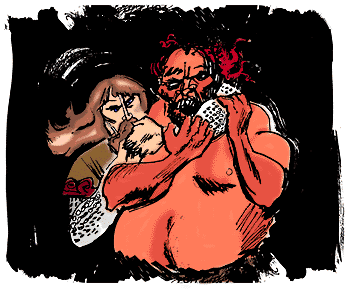
Grendel Attacks Again
Came then striding in the night
the walker of darkness.
In that
gabled hall
the warriors slept,
those who guarded the hall. .
.
all but one.
It was well known among men
that, if God
willed it not,
no one could drag
that demon to the shadows.
But
Beowulf watched
in anger, waiting
the battle's outcome.
Came then from the moor
under the misty hills
Grendel stalking
under
the weight of God's anger.
That wicked ravager
planned to
ensnare
many of the race of men
in the high hall.
He strode under the clouds,
seeking eagerly, till he came to
the
wine-hall, the treasure-hall
of men decorated in gold.
Nor was it
the first time he
had sought Hrothgar's home.
But never in his life
before
--or since--
did he find worse luck!
Came then to the building
that creature bereft of joys.
When he
touched it with his hands
the door gave way at once
though its bands
were forged
in fire. Intending evil,
enraged, he swung the door
wide,
stood at the building's mouth.
Quickly the foe moved
across
the well-made floor,
in an angry mood--a horrible light,
like fire,
in his eyes.
He saw the many warriors in the building,
that band of
kinsmen asleep
together, and his spirit laughed:
that monster
expected
to rip life from the body of each
one before morning
came.
He expected a plentiful meal.
(It was his fate
that he eat
no more
of the race of men
after that night. . .)
The mighty one, Beowulf, watched,
waiting to see how that wicked
one
would go about starting.
Nor did the wretch delay,
but set
about seizing
a sleeping warrior unawares
and bit into his bone
locks,
drinking the streams of blood,
then swallowing huge
morsels
of flesh. Quickly he ate that man,
even to his hands and
feet.
Forward Grendel came,
stepping nearer. Then
he
reached for Beowulf.
Beowulf grasped his arm
and sat up.
The criminal
knew he had not met
in this middle-earth
another
with such a grip.
Grendel's spirit was afraid
and his heart eager
to get away, to flee
to his hiding place, flee
to the devils he
kept
for company. Never had he met
a man such as this.
Beowulf then kept in mind
the speeches he had made
in the
evening and stood
upright, firmly grasping
Grendel's hand
until
the fingers broke.
The monster strove to escape.
Beowulf stepped closer. That
famous monster suddenly wanted
to disappear into the fens.
He
realized the power of those hands,
the wrathful grip he was in.
Grendel felt sorry
he had made a trip to Herot.
That hall of warriors dinned.
All the Danes of the city,
all the
brave ones, feared disaster.
The building resounded.
It is a wonder
the wine-hall
withstood the battle,
that the beautiful
building
did not fall to the ground.
But it was made fast,
within
and without,
with iron bands
forged with great skill.
I have
heard say
many a mead bench
adorned in gold
went flying
when
those hostiles fought.
No wise man had ever thought
that
splendid building could
be damaged (unless a fire
should swallow
it).
The din rose louder, the Danes stood
in dreadful
terror--everyone
heard lamentation, a terrifying
song, through the
wall:
Grendel, Hell's friend,
God's enemy, sang in
defeat,
bewailing his wound.
That man, mightiest
of warriors
alive, held fast.
He would not
for any reason
allow his
murderous visitor
to escape alive,
to keep the days of his life.
Beowulf's warriors brandished
many a sword, inheritances
from the
ancient days,
trying to protect their chief,
but that did no good:
they
could not have known, those
brave warriors as they
fought,
striking from all sides, seeking
to take Grendel's soul,
that
no battle sword could harm him--
he had enchantment against
the edges of weapons.
The end of Grendel's life was
miserable, and he would travel
far into the hands of fiends.
Grendel, the foe of God, who had
long troubled the spirits of men
with his crimes, found that
his body could not stand against
the hand grip of that warrior.
Each was hateful to the other
alive. The horrible monster endured
a wound: the bone-locks
of his shoulder gave way,
and his
sinews sprang out.
The glory of battle went to
Beowulf, and
Grendel,
mortally wounded,
sought his sad home
under the fen
slope.
He knew surely that
his life had reached its end,
the
number of his days gone.
The hope of the Danes
had come to pass--He
who came from far
had
cleansed Hrothgar's hall
and saved it from affliction.
They
rejoiced it that
night's work. Beowulf had
fulfilled his promise
to the Danes and all
the distress they had endured,
all the
trouble and sorrow,
had reached an end.
The fact was plain when
Beowulf laid that arm
and shoulder
down, there
altogether, Grendel's claw,
under the vaulted roof.
The Warriors Rejoice
I have heard say that
on that morning warriors
came from near
and far
to look at the wonder.
Grendel's death made
no warrior
sad.
They looked at the huge footprints
and the path he had
taken,
dragging himself wearily away
after he had been overcome in
battle.
The fated fugitive's bloody tracks
led into the
water-monster's mere.
There bloody water boiled,
a horrible swirl of
waves
mingled with hot gore.
That doomed one had died,
deprived
of joy,
in his fen refuge, his heathen
soul taken into Hell.
After seeing that place
the warriors once again
rode their horses
to Herot.
They spoke of Beowulf's
glorious deed, often
saying
that no man under the sky's
expanse, North nor South
between the seas, no man
who bore a shield, was more
worthy of a
kingdom. They,
however, never found fault
with the gracious
Hrothgar--
he was a good king.
The warriors let their
bay horses go, a contest
for the best
horse,
galloping through whatever
path looked fair.
Sometimes a
king's man, a warrior
covered in glory who knew
the old
traditions, would be
reminded of an ancient song,
and he would
call up words adorned
in truth. The man would think
of Beowulf's
deeds and quickly
compose a skillful tale in words.
Then he sang of things he'd heard
about Sigemund's valorous deeds,
untold things about Weals's son,
his struggles, his wide journeys
and feuds.
The singer told things the children
of men did not know,
except for
Fitela, Sigemund's nephew, who
stood with him in
battle.
With swords those two felled
many from the race of
giants.
After Sigemund's death day
not a little fame sprang to
him,
about his hardy fight and killing
of a dragon, keeper of a
hoard.
Under gray stone that prince alone
engaged in that audacious
deed,
not even Fitela with him.
Anyway, it happened that
Sigemund's sword went clear through
the
huge dragon and
that splendid iron
stuck in the wall.
The dragon
died violently.
By brave deeds the hero
won a ring hoard for
himself.
He bore into a ship's bosom
those bright treasures
of
the Weal kin,
and the dragon melted
of its own heat.
Sigemund was by far the most
renowned adventurer. N He had
first prospered under King Heremod,
but that man's strength
and
victory subsided.
Among the Jutes
Heremod was betrayed
into enemy
hands
and put to death.
Sorrow oppressed him too long.
He became
a trouble to his people.
Many a wise man
bewailed the old
days
when Heremod had taken
the protector's position
to hold the
treasure
of the Danish kingdom.
He had loved the Geats
more than
his own people:
evil had seized him.
Thus told the song.
Sometimes the warriors raced
their horses on the yellow road.
The morning sped away.
Many a brave warrior
went to the high
hall
to see the wonder.
So also the king himself,
the keeper of
the rings,
leaving the queen's rooms,
went with his famous
company.
And the queen also
with a troop of maidens
walked among
the mead seats.