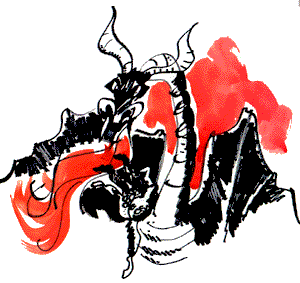
The adventures
of Beowulf, Episode 9
--Beowulf Becomes King / The Dragon
Attacks--
Later it happened,
after Hygelac fell
in the storm of war,
and
his son, Heardred,
fell too under his shield,
killed by the
sword
fighting the Swedes,
that the broad kingdom
came into
Beowulf's hand.
He held it well, ruled
fifty winters; he was
an old land
guardian.
Then in the dark nights
a dragon began to rule,
he who
guarded a hoard,
a steep stone burial mound
high on the heath.
A path led underneath
unknown to men.
But a certain
man
stumbled on it,
into the heathen hoard,
and took a cup,
a
large, decorated treasure.
The dragon did not hide
his opinion of
that deed;
the neighboring people
quickly learned his
anger.
But the thief did not
of his own accord
plunder
the treasure:
he was driven by need,
a fugitive from
justice.
Fleeing hostile blows
and in need of a roof,
he
stumbled in,
a man distressed.
He was amazed at what
he saw--a
precious
hoard, cups and weapons.
There were many such
ancient
treasures in
that earth house, for
in the old days a man
had
hidden the riches
of a noble, dying tribe there.
He was the last;
death
had taken the rest.
That lone survivor, knowing
death was near, mourning
his lost
friends, kept
those treasures all alone.
The cave stood near the
sea,
protected by secret spells.
He bore the treasures inside,
a
huge and worthy hoard
of worked gold. He said,
"Hold you now, Earth,
what
warriors could not. Lo,
from you first it was
taken.
War-Death has seized my people;
none of them can bear a
sword,
hold an ornamented cup. They
have gone elsewhere. Now
shall
the hard helmet and its golden
ornaments fall. Their
owners
sleep in death, those who
once wore the war-mask. So
it
is with the coat of mail,
which stood amid crashing shields,
held
off the bite of iron:
it lies, falling to pieces,
like the warrior
who owned it.
Never again will that armor
travel far on a war
chief
by the side of heroes.
There is no joy in the song,
no
pleasure in the harp.
No hawk sweeps over the hall.
No horse gallops
in the courtyard.
Death has sent off many men."
Thus, sad in mind,
he moaned his sorrow;
the lonely survivor
moved
day and night in sadness
until the flood of death
surged
into his heart.
The Dragon Attacks
An old night-ravager,
that one which, burning,
seeks a burial
mound,
the smooth dragon of malice
who flies by night
encompassed
in fire,
found the hoard
standing open.
Earth dwellers fear him much.
He must seek a hoard
in the earth,
where,
old in winters, he
will guard heathen
gold, though he
gains
nothing from it.
So that foe of the people,
exceedingly powerful,
guarded the
cave
three hundred winters
until a man
angered his heart,
took
a cup
to his master
asking for peace.
Peace was granted:
the
lord examined
the cup, the ancient
work of men.
So was the hoard
robbed,
ransacked of a treasure.
The dragon awoke,
and strife came: it
sniffed along the
stones,
found an intruder's footprints.
The thief had
stepped
with insidious craft
near the dragon's head.
(Thus may an
undoomed man
survive danger
if the Almighty
holds him in
favor.)
The hoard-keeper sought
eagerly along the ground,
looked for the
man
who had robbed him
while he slept.
Hot and fierce he
moved
about the cave. He
went completely around
the wasted place
but
no man was there.
Eager for battle, he
turned and turned
again
searching the cave,
but the golden cup was gone.
Anxiously he awaited
the fall of night;
enraged, the
cave-keeper
would with fire avenge
the loss of his cup.
When the
day was gone,
as the dragon wanted,
he no longer waited,
but went
in flame,
prepared with fire.
The beginning was fearful
to people in the land,
as was the
ending:
death for their king.
The fiend spouted fire,
burned
bright houses--
the glow of fire stood out,
a horror to the
people.
That terrible sky-flier
wished to leave
nothing
alive.
Near and far was seen
the dragon's violence,
how that
destroyer
hated and humbled the Geat
people. The people of the
land
were enveloped in fire.
At dawn he darted
back into his
cave.
He trusted in his war
and in his cavern.
But trust was to play him false.
Beowulf learned the
terror
quickly, in truth:
the surging fires
burned his
house,
the mead hall of the Geats.
That was sorrow
to the good
man,
the greatest of sorrows:
the wise king feared
he'd enraged
God,
broken a commandment.
His heart surged
with gloomy
thoughts,
which was not
his usual way.
The flame-dragon had
burned
the fortress of the people.
The war-king studied revenge.
End of episode nine