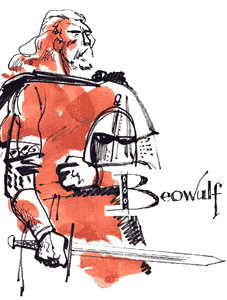
The adventures
of Beowulf, Episode 10
--We Learn of Beowulf's Reign and he
Prepares to Attack the Dragon--
That prince ordered
an iron shield:
he knew for a fact
that
the best wood,
the very best linden,
couldn't help
against
flame.
The good prince awaited
the last of his days,
the end of this
world's life,
and the dragon with him,
no matter how long
he'd
held the treasure.
Beowulf scorned a host,
a large army,
when he sought the
dragon;
he didn't fear
the dragon's war;
he trusted his
strength
and courage since he had
survived many battles,
the
flashings of battle gleams,
since the time he'd cleared
Hrothgar's
wine-hall
of Grendel's family,
that hateful race.
Nor was it a small battle
when the Geat king,
that lord of the
folk,
Hygelac, attacked Fresland
and died there
of sword
drinks,
beaten down by weapons.
Yet from that place Beowulf
came, down to the sea,
with thirty suits of battle
in his arms,
and in his strength
was able to swim.
The Hetware had no cause
for joy among their soldiers--
few of
those
who carried shields
left that battle
to seek their
homes.
Beowulf swam the wide water,
wretched, solitary,
back to
his people.
There Hygd, Hygelac's wife,
offered him treasure
and
the kingdom,
rings and the throne,
because she did not
trust her
son to keep them
from foreign armies.
But Beowulf would not
for any reason be
lord over his king's
son,
so he protected the boy,
gave him good council
till Heardred
became a man.
Banished men sought
Heardred over the sea,
sons of
Othere,
king of the Swedes;
they had rebelled
against their
lord,
the best of sea-kings.
That was Heardred's death-sentence,
the son of Hygelac:
for
entertaining those men
he died of sword strokes.
Then Ongentheow's
son
left for home, and Beowulf
held the gift seat,
ruled over
the Geats.
He was a good king.
He avenged Heardred's death
in
later days,
became to the wretched Eadgils
a friend,
supported
that son of Ohthere
over the wide sea
with men and
weapons.
On a cold expedition he
deprived king Onela of
life.
Thus had that son of Ecgtheow
survived each battle, terrible
war, much courage-work,
until the day when
he fought the
dragon.
Beowulf Visits the Dragon
Twelve enraged men
paid the dragon a visit.
The king had by
then
learned how the feud arose,
this affliction of men:
to his
possession had come,
through the hand of an informer,
the precious
cup.
The thief, the cause of this
strife, made thirteen, a saddened
captive, abjectly showing the way.
He went against his will
to
that earth-hall,
the one he'd found
near the surging sea,
by the
tossing water.
The inside was full
of works of art.
The awful keeper,
alert
fighter,
held those gold treasures,
old under the earth;
no man
would buy them cheap.
The brave king,
gold-friend of the Geats,
sat down on the
headland
and talked with his companions.
He was sad,
restless,
and ready to die.
That fate was near
which the old
man
would greet.
He would seek his reward,
life from body
parted;
not for long
would the soul of the prince
stay wrapped in
flesh.
Beowulf spoke:
"Often in youth
I survived
the storm of
battle,
the time of war.
I remember all that.
I was seven winters
old
when my father took me
to the king of the people.
Hrethal
gave me treasure
and feasting, remembering kinship.
I wasn't more
hateful
to him than any son
in his house--
than one of his
children--
Herebeald, Haethcyn, or my Hygelac.
The eldest was,
by
a kinsman's deed,
strewn on the bed of death--
Haethcyn struck his
lord
and brother with the arrow
from a bow: missed the mark
and
killed his kinsman
with a bloody arrow.
That was a feud that
couldn't be fought.
Weary it is to the heart:
That prince lost
his life
. . .unavenged.
That felt just as it does
for an old man
to await
the swinging of his son
on the gallows.
He sings a
mournful song
when his son hangs
a feast to ravens
and, though
old and wise,
he cannot help.
Every morning calls to mind
the
journey of his son
to elsewhere--the father
cares not to wait
for
the other heirs
when he has, through
an unavoidable
death,
experienced an evil.
Sorrow is in the home,
the wine-hall
abandoned,
bereft of joy.
The riders sleep,
warriors in the
grave;
there is no harp song,
no joy in the court.
Not as there
once was.
Comes then from the bedstead
a song of sorrow.
The
house and fields
seem too large."
So Beowulf spoke
of his sorrow
for Herebeald.
He could
not
for that murder
seek revenge,
though the doer
was not dear
to him.
"When that sorrow befell Hrethal
he gave up the joys of men
and
chose God's light.
He left to his offspring
a land and a
people.
Then were accusations
across the water,
severe
hostility
from the war-like sons
of Ongentheow. They would
have
nothing of friendship,
but around Hreosnaburg
planned a terrible
slaughter.
My kinsmen avenged that,
the feud and crime,
as is
well known,
though one paid with his life,
a hard bargain:
for
Haethcyn the battle was fatal.
And I've heard tell
how another
kinsman
attacked his slayer
with sword's edge;
When Ongentheow
sought Eofor
he found his helmet split,
fell down, battle pale.
I
repaid Hygelac
for the favors he'd shown,
lands and a house,
with
my bright sword.
(He needn't look
for a worse man).
I went alone
in the front,
and will so ever,
as long as this sword lasts
which
has served me so well.
I was the killer of Daghrefin,
the Huga
champion.
He brought no treasures
back from the battle
to the
Frisian king
but died in the fight,
that banner guardian,
a
prince in bravery.
Nor was my sword his death,
but my hand
grasp
broke his bone-house,
tore out his surging heart.
Now shall
the sword's edge,
hands and hard sword,
fight over this hoard."
Then Beowulf made his last boast:
"I ventured many battles
in my
youth; now, old,
I will seek another,
try again for glorious
deeds, if that avenger
will come out."
He spoke to each
of his brave companions
for the last time:
"I
would not use a sword
against this monster
if I might otherwise
fight,
as I did with Grendel.
But how else fight fire?
a breath
of poison?
Therefore I wear shield and mail.
I will not back
a
step away
from that hoard-guardian.
We two shall end
as fate
decrees.
I am brave in mind,
so I go against the war-flyer
in no
need
of further boasting.
You men wait on the hill,
protect the
war-gear
and see which will,
after the death rush,
come away
unwounded.
This is not your duty,
nor in the power of man.
No one
but myself
can fight this monster.
Your lord shall either
win the
treasure
or lose his life."
The brave in battle arose then,
bore his shield and mail,
trusting his strength
under the stone cliffs.
(This is not the
coward's way).
end of episode ten
* * *
In episode
eleven Beowulf shows what he's made
of.