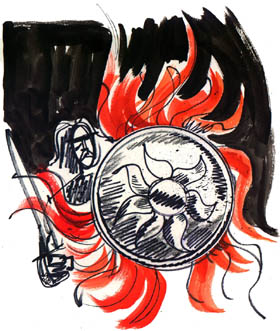
The adventures
of Beowulf, Episode 11
--Beowulf Fights the
Dragon--
He saw by the cave,
he who had many virtues,
he who had survived
many times
the battle flashes
when troops rush together,
a stream
running
from the stone arch--
a stream of fire.
He could not enter
for the dragon's flame.
Beowulf was
angry,
the lord of the Geats,
he who stormed in battle.
He yelled
into the cave.
The hoard-keeper perceived
a man's voice and
didn't plan to ask
for friendship.
Flames shot out
from among the stones,
hot
battle-sweat.
The ground dinned.
The hero raised his shield
against the dreadful stranger.
Then
the coiled thing
sought battle.
The war king drew his sword,
an
ancient heirloom
with edges unblunt.
Each of them intended
horror
to the other.
Stouthearted stood that war-prince
with his shield
upraised,
waited in his war-gear.
The dragon coiled
together,
went forth burning,
gliding toward his fate.
His shield protected
life and body
for a shorter time
than the
prince had hoped.
That was the first day
he was not granted
glory
in battle.
The lord of the Geats
raised his arm,
struck the
horrible thing
with his ancestral sword,
but the edge gave
way:
that bright sword
bit less on the bone
than the war-king
needed.
After that stroke
the cave-guardian
was in a savage mood.
He
threw death-fire--
widely sprayed
battle flashes.
The gold-friend
of the Geats
wasn't boasting of victory.
His war-sword had
failed,
not bitten home
as it should have,
that iron which
had
always been trustworthy.
This wasn't a pleasant trip:
that
famous king, Beowulf,
would have to leave this earth,
would have,
against his will,
to move elsewhere.
(So must every man
give
up
these transitory days.)
It wasn't long before
the terrible ones
met again--
The
hoard-keeper took heart,
heaved his fire anew.
He who once ruled a
nation
was encircled by fire;
no troop of friends,
strong
princes,
stood around him:
they ran to the woods
to save their
lives.
Yet in one of them
welled a sorrowful heart.
That true-minded
one
didn't forget kinship.
Wiglaf he was called,
the son of
Woehstan,
a beloved shield-warrior,
a lord of the Scylfings,
a
kinsman of Aelthere.
He saw his lord
suffering from heat
under
his helmet.
He remembered the gifts,
a rich home among
the
Waegmundings,
the rich inheritance,
that his father had had.
Wiglaf could not refrain,
but grabbed his shield,
drew his
ancient sword
that among men was known
as the heirloom of
Eanmund,
the son of Othere.
(Eanmund, after a quarrel,
was killed
by Weohstan
with the sword's edge.
Weohstan became
a friendless
exile.
To Eanmund's own kinsmen
he bore the burnished helmet,
the
ring-locked mail,
the old sword made by giants.
Onela had given
Eanmund that,
the war-equipment,
and did not mention
the feud,
though his
brother's child was killed.
Weohstan held the
treasure
many years,
the sword and mail,
until his son
could
do heroic deeds
as his father had done.
He gave the
war-dress to Wiglaf
and a great many treasures,
then departed this
earth
old on his journey.
But this was the first time
the young
champion
had gone into the war-storm.)
His spirit did not fail,
nor his heirloom: that
the dragon
discovered
when they met in battle.
Wiglaf spoke words about duty,
said in sorrow to his
companions:
"I remember the times
we drank mead and how
we
promised our lord
there in the beer-hall,
he who gave us
gifts,
that we would repay
all his largess,
the helmets and hard
swords,
if the need
should ever befall.
He chose his best
men
for this expedition,
gave us honor and
these treasures
because
he considered us best
among spear fighters,
though he
proposed to
do the job alone because
he had performed the most
famous deeds among men.
Now has the day come
that our lord
is
in need of fighters,
of good warriors.
Let us go to him,
help the
war-chief
in this fire-horror.
God knows, to me,
my lord means
more
than my skin.
With him I will
embrace the fire.
It isn't
proper
that we bare shields
back to our homes
before we
can
defend our lord
and kill the enemy.
He doesn't deserve
to
suffer alone.
We two shall share
the sword and helmet,
the mail
and war-garment."
Then Wiglaf advanced
through the
death-fumes,
wore his helmet
to help his lord.
He spoke
these words:
"Dear Beowulf, may you
accomplish all well,
as you
did in youth,
as I have heard tell.
Don't surrender the glory
of
your life. Defend now,
with all your strength,
your brave
deeds.
I will help."
After these words
the dragon
angrily came;
the terrible spirit
another time attacked
with
surging fire.
Fire waves burned
Wiglaf's shield
down to the
handle,
his mail could not
protect the young
spear-warrior.
He
ducked behind
his kinsman's shield.
Then the
war-king
remembered past deeds,
struck mightily with his sword
so
that it stuck
in the dragon's head;
Naegling, the great sword of
Beowulf,
ancient and shining,
broke, failed in battle.
Fate had
not granted that
the iron sword would help.
(I've heard
that Beowulf's
swing was too strong
for any sword,
overstrained
any blade,
anytime he carried
a blood-hardened sword
into
battle.)
Then the terrible dragon
a third time
rushed,
hot and battle-grim.
He bit Beowulf's neck
with sharp
tusks--Beowulf
was wet with life's blood;
blood gushed in waves.
Then, I've heard,
Wiglaf showed courage,
craft and bravery,
as
was his nature--he went
not for the thought-seat,
but struck a
little lower,
helped his kinsman
though his hand was burned.
The
sword, shining
and ornamented,
drove in so that
the fire
abated.
Then the king controlled
his senses, drew his
battle knife,
bitter
and battle sharp, which
he carried on his mail,
and cut
the dragon
through the middle.
The enemy fell--strength
had
driven out life;
the two kinsmen, together,
had cut down the
enemy.
So should a warrior do.
That was Beowulf's last victory;
his last work in this world.
end of episode eleven